Treatment Guides
All-on-4 Dental Implants Explained
All-on-4 replaces a full arch of teeth with a fixed bridge supported by four implants. Here is how the concept works, who it may suit and what living with it involves.
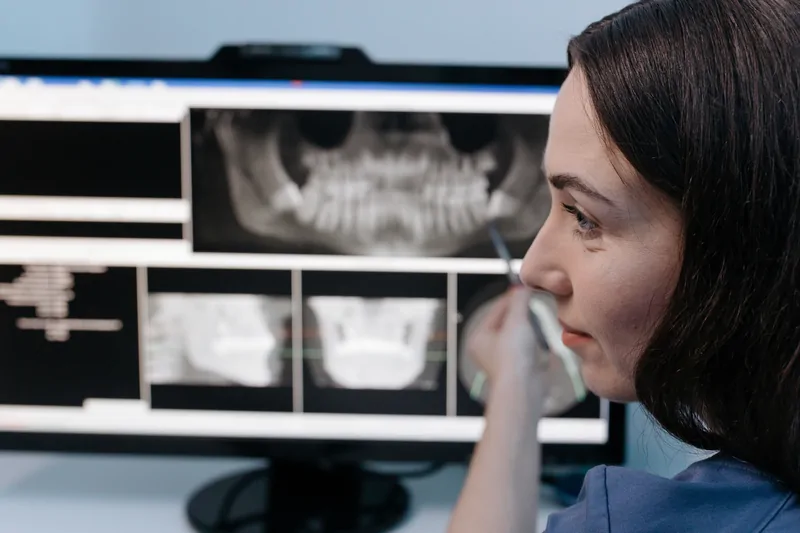
What All-on-4 means
All-on-4 is a way of replacing a complete arch of teeth, upper or lower, with a fixed bridge supported by four dental implants. Unlike a conventional denture, the bridge is not removed by the patient each night. It is attached to the implants and is taken out only by a clinician during maintenance appointments.
The approach is often discussed by people who have lost most or all of their teeth in one jaw, who have many failing teeth, or who struggle with a loose removable denture. For the right patient, it can offer a stable, fixed set of teeth with a relatively streamlined surgical plan.
Why the back implants are tilted
A defining feature of All-on-4 is the angle of the two rear implants. The two front implants are usually placed fairly upright, while the two back implants are tilted towards the rear of the mouth.
Tilting them allows longer implants to be anchored in available bone and spreads support further back along the arch. In the upper jaw, this can help work around the sinuses; in the lower jaw, it can help avoid the nerve that runs through the bone. In some patients, this means a fixed bridge may be possible without bone grafting or a sinus lift, although that is never assumed and depends entirely on the imaging.
All-on-4 supports a fixed full-arch bridge on four implants, with the back two placed at an angle.
Assessment and suitability
Not everyone is a candidate, and a thorough assessment is essential. A CBCT scan is used to measure bone height and width, locate nerves and sinuses and plan the implant positions. Your clinician will also consider your general health, your gums, your bite and your expectations.
- Sufficient bone in the key areas, judged on 3D imaging
- General health that allows oral surgery and healing
- Smoking status and control of conditions such as diabetes
- Grinding or clenching habits, which affect bridge design and material
- Willingness to keep up daily cleaning and regular maintenance
Temporary bridge and final bridge
In many cases, a fixed temporary bridge can be attached shortly after the implants are placed, provided they are stable enough at surgery. This means patients may not have to go without teeth during healing. The temporary bridge is usually made from acrylic or a similar material and is designed to be lighter and more forgiving while the implants integrate with the bone.
During this healing period, which typically lasts several months, a soft diet is usually advised and the temporary bridge should not be used for hard or tough foods. The gums also change shape as they heal, which is one reason a temporary stage is helpful.
Once healing is confirmed, the final bridge is made. Depending on the case, it may be constructed from materials such as zirconia or a metal framework with acrylic or ceramic teeth. The final bridge is typically stronger and more refined in appearance, and its design is adapted to the healed gum contours, your bite and your facial profile.
How All-on-6 compares
All-on-6 follows the same principle but uses six implants rather than four. Additional implants can distribute biting forces across more support points and, for some patients, provide extra security should one implant ever encounter a problem. It may also allow different bridge designs.
The trade-off is that more implants require adequate bone in more locations, and the surgery is somewhat more extensive. Neither option is automatically better. The decision rests on bone volume, jaw size, the forces your bite generates and your clinician’s assessment of what will offer stable long-term support.
- All-on-4: four implants, tilted back implants, may avoid grafting in some cases
- All-on-6: six implants, more support points, needs bone in more areas
- Both: fixed full-arch bridge, temporary then final stage, ongoing maintenance
Planning around travel
For patients travelling to Istanbul, All-on-4 is usually organised into at least two visits: one for assessment, any extractions, implant placement and the temporary bridge, and another after healing for the final bridge. Some cases need additional appointments for adjustments or grafting.
It is sensible to allow several days after surgery before flying home so that early healing can be checked. Ask for written records of the implant system and components used, and keep your local dentist informed so that they can support routine care between visits.
Maintenance over the years
A fixed bridge needs consistent care. Food and plaque can collect beneath it, and the gum around implants is vulnerable to inflammation if not cleaned well. Your clinician or hygienist will show you how to use interdental brushes, water flossers or special floss to clean under the bridge.
Regular professional reviews are important. At these appointments the bridge may be removed periodically for thorough cleaning, the implants and screws checked, and the bite assessed. Over time, components such as screws or acrylic teeth may need replacing, and if you grind your teeth, a night guard may be suggested to protect the bridge.
Is it right for you?
All-on-4 can transform daily comfort for people living with missing or failing teeth, but it is a significant treatment with long-term responsibilities. Understanding the stages, the healing period and the maintenance involved helps you decide with confidence.
If you would like to explore whether All-on-4, All-on-6 or another approach may suit you, VERAKS HEALTH can arrange a consultation in which one of our doctors reviews your situation and talks you through the options.
Key takeaways
- All-on-4 supports a fixed full-arch bridge on four implants, with the back two placed at an angle.
- Tilted implants may reduce the need for grafting in some patients, but only imaging can confirm this.
- A temporary bridge is often fitted soon after surgery, followed by a final bridge after healing.
- All-on-6 uses more implants and needs bone in more locations; neither option is right for everyone.
- Daily cleaning under the bridge and regular professional reviews are essential.

Written by the VERAKS HEALTH Editorial Team. This article is general education. It is not medical advice and does not replace an examination by a qualified clinician. Medical disclaimer.
The journal
Reading for
the curious.
Guides on treatments, recovery and travelling to Istanbul — written to help you ask better questions.
All articles





Free consultation
Ready when you are — let’s talk.
Share what you’d like to change. A coordinator replies personally, explains what a clinician would need to see and answers your practical questions.