Dental Health
Dental Implants vs Bridges: How to Think About the Choice
Both options can restore a confident smile after tooth loss, but they work on very different principles. Here is a calm, practical way to weigh them up before your assessment.
Two different answers to the same gap
Losing a tooth, whether through decay, injury or gum disease, leaves more than a visible space. Neighbouring teeth can gradually drift, the opposing tooth may over-erupt, and chewing on that side often becomes less comfortable. Replacing the missing tooth is usually about restoring function and protecting the rest of the mouth as much as it is about appearance.
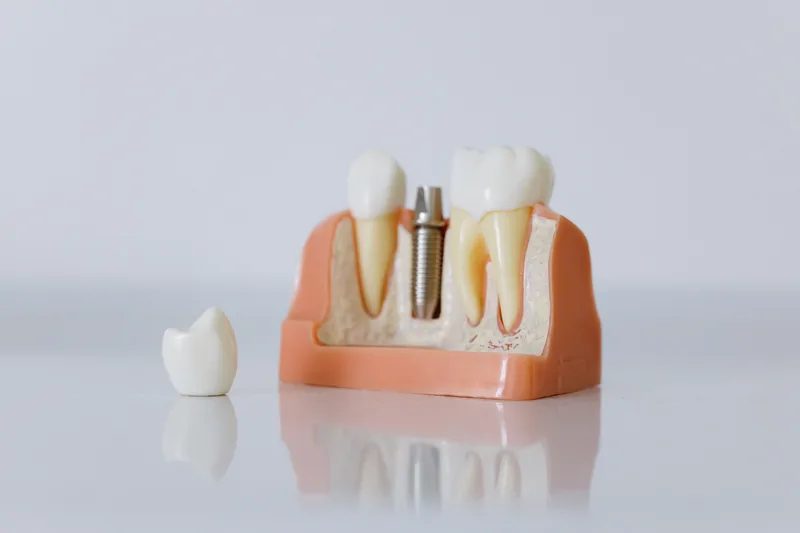
A dental implant and a dental bridge are two of the most commonly discussed fixed options. Both are designed to stay in place rather than be removed each night, and both can look natural when planned carefully. The difference lies in how they are supported. An implant replaces the root of the tooth with a small titanium or zirconia post placed in the jawbone, which then carries a crown. A conventional bridge, by contrast, uses the teeth on either side of the gap as anchors, with a replacement tooth suspended between them.
Neither option is automatically “better”. The more useful question is which approach suits your mouth, your health, your timeline and your priorities. That is a conversation to have with a clinician who has examined you, but understanding the principles beforehand can make that conversation far more productive.
How a dental implant works
An implant is placed in a minor surgical procedure, usually under local anaesthetic. Over the following weeks to months, the bone typically bonds with the implant surface in a process known as osseointegration. Once the implant is stable, a connecting piece called an abutment is fitted and a custom crown is attached on top.
Planning usually begins with a detailed examination and three-dimensional imaging, which helps the clinician assess bone height, width and the position of nearby structures such as nerves and sinuses. In some cases a temporary tooth can be worn during the healing phase so that the gap is not visible, although this depends on the site and the stability of the implant.
Because the implant stands on its own, the neighbouring teeth do not need to be reshaped. Many patients value this, particularly when the adjacent teeth are healthy and unrestored. An implant also transmits chewing forces into the jawbone, which may help maintain bone volume in that area over time, although bone changes vary from person to person.
- Usually involves a planning stage with imaging such as a 3D scan
- Healing time between placement and the final crown is often several months
- Adequate bone volume and healthy gums are important for stability
- Bone grafting may be suggested in some cases before or during placement
- Long-term success depends heavily on daily hygiene and regular check-ups
Implants replace the tooth root and stand independently; bridges rely on the neighbouring teeth for support.
How a dental bridge works
A traditional fixed bridge is made of a replacement tooth, called a pontic, joined to crowns that fit over the teeth on either side of the gap. To make room for those crowns, the supporting teeth are prepared by removing a layer of enamel. Impressions or a digital scan are taken, a temporary bridge may be fitted, and the final bridge is then cemented in place.
The appeal of a bridge is often its directness. There is no surgical stage and, in many cases, the process can be completed over a shorter period than an implant. When the neighbouring teeth already have large fillings or crowns, covering them as part of a bridge can sometimes be a sensible use of treatment that may have been needed anyway.
Bridges can be made from several materials, including porcelain fused to metal, zirconia and lithium disilicate ceramics. Your clinician can explain which materials may suit the position of the gap, the strength required and the appearance you are hoping for.
Factors that shape the decision
When clinicians compare implants and bridges for a particular patient, they tend to look at a combination of clinical and personal factors. Some of these can only be judged through examination and imaging, while others depend on what matters most to you.
- The health and condition of the teeth next to the gap
- Bone volume and density at the site of the missing tooth
- Gum health and any history of periodontal disease
- General health, medications and smoking habits, which can affect healing
- How much time you can give to treatment and how many visits are practical
- Your preferences about surgery, tooth preparation and long-term maintenance
Living with each option
Day-to-day care differs slightly between the two. An implant crown is cleaned much like a natural tooth, with brushing and flossing or interdental brushes around the gumline. The tissue around an implant can become inflamed if plaque builds up, so attentive cleaning and professional reviews are important.
A bridge needs particular attention underneath the pontic, where food and plaque can collect. Floss threaders, water flossers or specially shaped brushes are often recommended. Because the supporting teeth carry extra load and are covered by crowns, keeping their margins clean helps reduce the risk of decay at the edges.
Both restorations can last for many years with good care, but neither should be thought of as lasting forever. Crowns on implants and bridges may eventually need replacement because of wear, chipping or changes in the surrounding gums. Regular dental check-ups allow small issues to be spotted early.
Questions worth asking your clinician
Arriving with a few clear questions can help you leave your appointment with a genuine understanding of your options rather than a list of technical terms. It is reasonable to ask a clinician to explain their reasoning and to describe what would happen if you chose the alternative.
- Are my neighbouring teeth strong enough to support a bridge?
- Do I have enough bone for an implant, or would grafting be needed?
- How many visits would each option involve, and over what period?
- What would maintenance look like in the years ahead?
- What are the main risks for me specifically with each approach?
- Are there other options, such as a removable partial denture, worth considering?
Making a choice that fits you
For some people, the opportunity to leave healthy neighbouring teeth untouched makes an implant the more appealing route. For others, avoiding surgery or completing treatment in fewer visits points towards a bridge. Many patients find that once their specific situation is assessed, one option simply makes more sense than the other.
It is also worth remembering that planning carefully is time well spent. A thorough examination, good imaging and an honest discussion of your goals tend to lead to more predictable outcomes than rushing towards a particular solution. If you are weighing up an implant or a bridge, a personal consultation arranged through VERAKS HEALTH is the right place to review your options in detail.
Key takeaways
- Implants replace the tooth root and stand independently; bridges rely on the neighbouring teeth for support.
- Implants usually take longer overall and involve a surgical stage, while bridges require reshaping adjacent teeth.
- Bone volume, gum health, general health and the condition of nearby teeth all influence which option may suit you.
- Both restorations need diligent daily cleaning and regular professional reviews.

Written by the VERAKS HEALTH Editorial Team. This article is general education. It is not medical advice and does not replace an examination by a qualified clinician. Medical disclaimer.
The journal
Reading for
the curious.
Guides on treatments, recovery and travelling to Istanbul — written to help you ask better questions.
All articles







Free consultation
Ready when you are — let’s talk.
Share what you’d like to change. A coordinator replies personally, explains what a clinician would need to see and answers your practical questions.