Hair Restoration
What Is Sapphire FUE? Hair Transplantation Explained
Sapphire FUE is widely advertised, but the name can be misleading. Here is what the sapphire part actually refers to, and how it fits into an FUE procedure.
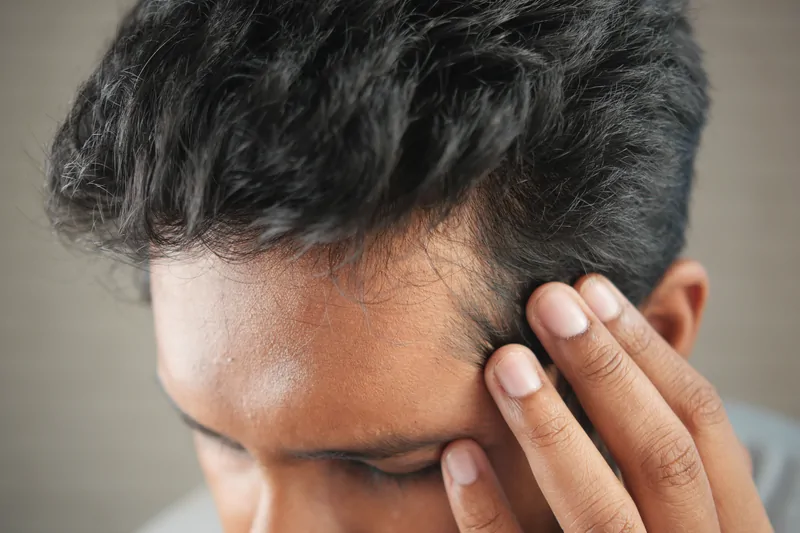
What the name means
Sapphire FUE has become a familiar phrase in hair restoration, and it is sometimes presented as a separate technique altogether. In reality, it describes a specific step within a Follicular Unit Extraction procedure rather than a different way of moving hair.
The extraction of grafts from the donor area is carried out in the same way as in standard FUE. The word sapphire refers to the blade used to open the small channels in the recipient area, into which the grafts are later placed. Instead of a steel blade, the surgeon uses a blade with a tip made from sapphire.
Where sapphire blades fit in
An FUE procedure has three broad stages: extraction, channel opening and implantation. Sapphire blades are used only in the second of these. They have no role in removing grafts, and they do not change how grafts are stored or placed.
Channel opening matters because the angle, direction, depth and spacing of each channel shape how the transplanted hair will grow and how natural it will look. The choice of blade is one of many tools a surgeon may use to carry out this step, and preferences vary between clinicians.
- Extraction: grafts are removed individually with a fine punch, as in any FUE procedure
- Channel opening: sapphire-tipped blades create the recipient sites
- Implantation: grafts are placed into the channels with fine forceps
Sapphire FUE is FUE extraction combined with sapphire-tipped blades for channel opening.
Why some surgeons use sapphire
Sapphire is a very hard material that can be shaped into a fine, smooth edge. Some surgeons prefer sapphire blades for the precision and consistency they feel they offer when creating small channels, particularly where many sites need to be opened close together.
It is worth approaching broader claims with care. You may see suggestions that sapphire blades always lead to faster healing, less scabbing or greater density. Outcomes depend on many factors, and the blade is only one of them. The skill of the surgeon in designing and opening the channels is generally far more important than the material of the instrument.
What really influences the result
Whatever blade is used, the result of a hair transplant depends on the overall plan and the care with which it is carried out. The donor area is limited, so how many grafts are taken, and from where, needs careful consideration. A plan should also allow for the possibility that hair loss continues in the future.
Hairline design is another major factor. A natural hairline is usually soft and slightly irregular, with finer single-hair grafts at the front. It should suit your face and age, and look appropriate as you grow older.
- The quality and capacity of the donor area
- The design of the hairline and the distribution of density
- How gently grafts are extracted, stored and handled
- The angle and direction of each channel
- Your hair characteristics, health and aftercare
Recovery after Sapphire FUE
Recovery is broadly similar to other FUE procedures. Small crusts usually form in the recipient area during the first days, and some redness and swelling around the forehead can occur. The donor area typically heals over a week or two. You will be given instructions on sleeping position, washing and avoiding pressure on the grafts.
Transplanted hairs commonly shed in the weeks after the procedure. This is a normal part of the hair cycle, and new growth usually starts to appear gradually over the following months. Final results take time to develop, and it is wise to judge progress over many months rather than weeks.
- Follow the washing routine given by your clinical team
- Avoid touching, scratching or rubbing the recipient area
- Protect the scalp from direct sun as advised
- Report anything unusual, such as increasing pain or signs of infection
Is it right for you?
Rather than choosing a procedure by its name, it is more useful to focus on the plan behind it. Ask how the channels will be opened and why, how the hairline will be designed and how the donor area will be protected for the future. Sapphire FUE, standard FUE and DHI each have their place, and some surgeons combine approaches within one procedure.
Suitability for any hair transplant, and the most appropriate technique, can only be decided after an individual assessment. VERAKS HEALTH can arrange a consultation in which one of our doctors examines your scalp and discusses the options with you.
Key takeaways
- Sapphire FUE is FUE extraction combined with sapphire-tipped blades for channel opening.
- Sapphire blades play no part in extracting grafts.
- Surgeon skill, planning and graft handling matter more than the blade material.
- Recovery and growth follow a similar pattern to other FUE procedures.

Written by the VERAKS HEALTH Editorial Team. This article is general education. It is not medical advice and does not replace an examination by a qualified clinician. Medical disclaimer.
The journal
Reading for
the curious.
Guides on treatments, recovery and travelling to Istanbul — written to help you ask better questions.
All articles





Free consultation
Ready when you are — let’s talk.
Share what you’d like to change. A coordinator replies personally, explains what a clinician would need to see and answers your practical questions.