Treatment Guides
Veneers vs Crowns: What Actually Differs
Veneers and crowns are often mentioned in the same breath, but they are designed for different jobs. Understanding coverage, preparation and purpose makes the choice far easier to follow.
Why the two are so often confused
Search for ways to improve a smile and you will quickly meet both veneers and crowns. Before-and-after photographs of either can look remarkably similar: brighter, more even teeth with a harmonious shape. It is no surprise that many people assume the two are interchangeable.
In reality, they are designed with different goals in mind. A veneer is primarily a cosmetic restoration that covers the visible front surface of a tooth. A crown is a restoration that covers the entire tooth above the gumline, and it is frequently used to protect or rebuild a tooth that is weakened. The right choice depends less on the look you want and more on the condition of the teeth underneath.
What a veneer is
A veneer is a thin shell, usually made of porcelain or composite resin, bonded to the front of a tooth. Porcelain veneers are crafted in a dental laboratory, often from feldspathic porcelain or lithium disilicate, and can be very thin. Composite veneers are built up directly on the tooth in the chair.
Porcelain and composite each have their own character. Porcelain tends to resist staining well and can reproduce the subtle translucency of natural enamel, but it requires laboratory time and is more involved to repair if chipped. Composite can often be completed in fewer visits and adjusted more easily, though it may pick up stains and need polishing or refreshing sooner. Your clinician can talk through which material may suit your teeth, habits and expectations.
Veneers are generally considered for teeth that are structurally sound but have cosmetic concerns. Because they cover only the front and part of the biting edge, they typically require less tooth reduction than a crown. In some situations, minimal-preparation or so-called laminate veneers may be possible, although whether this is appropriate depends on tooth position and the result you are aiming for.
- Discolouration that does not respond well to whitening
- Small chips or worn edges on otherwise healthy teeth
- Minor gaps or slight irregularities in shape
- Teeth that appear short or uneven in proportion
Veneers cover the front of a tooth and are mainly cosmetic; crowns cover the entire tooth and often add protection.
What a crown is
A crown, sometimes called a cap, encases the whole visible portion of the tooth. To make space for it, the tooth is shaped on all sides. The crown is then cemented over the prepared tooth, restoring its shape, strength and appearance.
Crowns can be made from zirconia, lithium disilicate, porcelain fused to metal and other materials. Each has its own balance of strength and translucency. Zirconia is often chosen where durability under biting forces is a priority, while glass ceramics may be favoured for front teeth where light transmission matters more. Your clinician will usually explain why a particular material is suggested for your case.
Crowns are often recommended when a tooth has lost significant structure. This might follow a large filling, a fracture, extensive wear from grinding or root canal treatment, after which back teeth in particular can become more brittle. In these situations, a veneer may not offer enough support to protect the tooth.
The key differences side by side
Thinking about a few practical dimensions can make the distinction clearer. These are generalisations, and individual cases can vary, but they capture the main contrasts.
- Coverage: veneers cover the front surface; crowns cover the whole tooth
- Tooth preparation: veneers usually need less reduction; crowns require shaping on all sides
- Purpose: veneers are mainly cosmetic; crowns are often both protective and cosmetic
- Ideal starting point: veneers suit sound teeth; crowns suit weakened or heavily restored teeth
- Position: veneers are mostly used on teeth visible when smiling; crowns can be used anywhere in the mouth
Things to consider before choosing
Both treatments are generally irreversible once enamel has been removed, so it is worth taking time to understand what is involved. A veneer or crown will eventually need replacing, and the underlying tooth will always need some form of covering after preparation.
Your bite matters too. Patients who grind or clench their teeth may place considerable stress on thin porcelain, and a clinician may suggest a night guard, a different material or a different approach altogether. Gum health is another consideration, as inflamed or receding gums can affect how restorations look and last.
Some people experience temporary sensitivity after preparation, and there is a small chance that a prepared tooth may later need root canal treatment, particularly when preparation is more extensive. Restorations can also chip or loosen. These risks are part of an honest conversation about any veneer or crown plan.
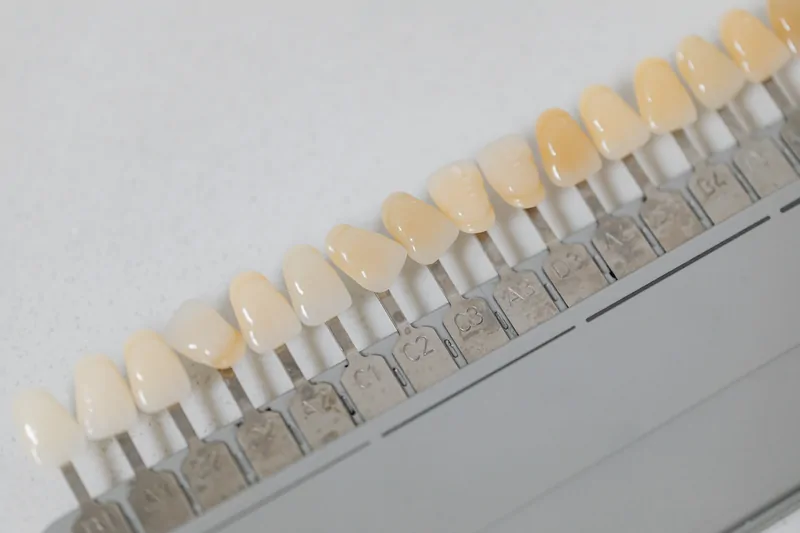
It is also sensible to think about the wider smile. Treating one or two teeth can create colour or shape mismatches with neighbouring teeth, so some patients choose to whiten first and match restorations to their new shade. A smile design consultation can help visualise how different options might look before anything is changed.
Combining treatments
It is quite common for a treatment plan to use both veneers and crowns. A patient might have healthy front teeth suited to veneers alongside a previously root-treated tooth that needs the protection of a crown. With careful shade selection and laboratory communication, the two can be made to blend together.
Other treatments may also play a role. Orthodontic alignment with clear aligners or braces can sometimes reduce the amount of tooth preparation needed later, or even remove the need for restorations in mild cases. Teeth whitening, bonding and gum contouring are further tools that may be discussed depending on your goals.
Finding the right path for your smile
The most reliable way to decide between a veneer and a crown is a thorough examination, including an assessment of tooth structure, existing fillings, gum condition and bite. X-rays and digital scans can reveal details that are invisible in a mirror.
It can also help to ask to see a preview of the planned result. Depending on the case, this might be a digital simulation, a wax-up model or a temporary trial smile placed over your existing teeth. These previews are not exact replicas of the final restorations, but they offer a valuable chance to comment on length, shape and proportion before permanent work begins.
If you would like to understand whether veneers, crowns or a combination may suit your teeth, a personal consultation arranged through VERAKS HEALTH can help you explore your options with clarity.
Key takeaways
- Veneers cover the front of a tooth and are mainly cosmetic; crowns cover the entire tooth and often add protection.
- Veneers usually require less tooth reduction, while crowns suit teeth that are weakened or heavily restored.
- Bite habits such as grinding, gum health and existing fillings all influence which option may be appropriate.
- Many treatment plans combine veneers, crowns and other options such as whitening or alignment.

Written by the VERAKS HEALTH Editorial Team. This article is general education. It is not medical advice and does not replace an examination by a qualified clinician. Medical disclaimer.
The journal
Reading for
the curious.
Guides on treatments, recovery and travelling to Istanbul — written to help you ask better questions.
All articles






Free consultation
Ready when you are — let’s talk.
Share what you’d like to change. A coordinator replies personally, explains what a clinician would need to see and answers your practical questions.